On America's 250th, my people know another story | Opinion
Digital Edition published on 7/2/26 and Paper Sunday Edition published on 7/5/26
Jaynie Parrish For The Republic July 2, 2026, 5:03 a.m. MT
Whew! I have one less thing to worry about.
Let me back up: I saw the Supreme Court was going to rule on the issue of timing for mail-in ballots and thought the worst. This is the court that has supported the Trump administration’s attack on the Voting Rights Act and other rewriting of election policies, including letting politicians pick their voters through redistricting.
Instead, Monday’s ruling was good news. The justices upheld state laws that allow late-arriving mail-in ballots to count. That’s especially important in states that count ballots that are postmarked before Election Day.
For those of us doing voting rights work on tribal lands in Arizona, this was another attack on the process. Arizona Native Vote estimates more than 63 percent of voters on tribal lands in Apache and Navajo Counties vote by mail. Of course, in Arizona, ballots already need to be received by Election Day, so we have to educate people about when to drop their ballots in the mail or make sure they get to a drop box or an election center by the deadline.
I think about Betty John.
Betty is a community member on the Navajo Nation. And in 2024, six members of her family could not vote -- not because they weren't citizens, but because barrier after barrier -- distance, mail delays, documentation gaps -- stood between them and the ballot box. Six people. One family. One election. That is not an anomaly out here. That is a pattern.
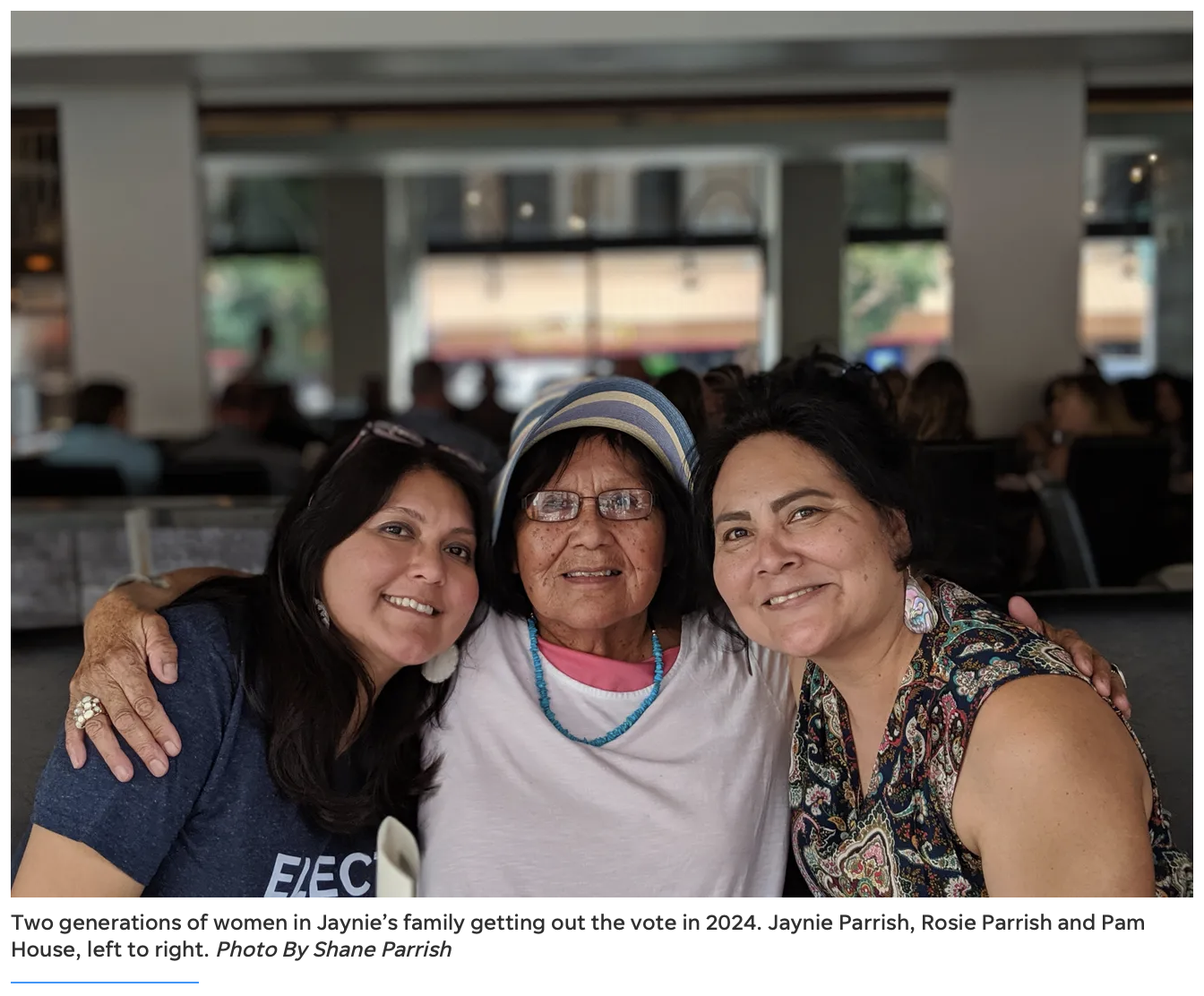
I also think about my mother, Rosie Parrish. She has never had a birth certificate. In this country, at this moment, that fact carries new and frightening weight. But this week, the Supreme Court gave us hope with two important decisions. On Monday, the justices upheld state laws counting late-arriving mail-in ballots. On Tuesday, they affirmed birthright citizenship. This is important to us because Native people have been on this land for thousands of years, and we are being asked to prove we belong here. That’s not just a bureaucratic hurdle. It is something much older and uglier.
These are the stories I carry into every conversation about voting rights. Not abstractions. Real people. Real families.
Vote early. Vote now.
Arizona's primary election day is July 21. Early voting is open right now. I am asking our relatives -- and every Arizonan who cares about having a say -- to vote as soon as possible.
If you vote by mail, fill out your ballot today and drop it at your nearest county drop box. Don’t wait for the postal service. We are already seeing efforts to disrupt mail delivery, and rural Native voters on the Navajo Nation and across tribal lands already experience delays that most urban voters never think about. That is not an accident. It is a pattern.
If you vote in person, find your early voting location through your county recorder's website. You can also check your ballot status and voter registration at my.arizona.vote.
Voter education and preparation are still our strongest tools. Encourage your family to vote early. And make sure that you drop that ballot off.
The attacks are connected
What I want people to understand is that the assault on mail-in voting doesn't exist in isolation. There has been a step-by-step dismantling of what we assumed was a shared idea about civics: do your part, vote.
Attacks on voting are designed to limit the power of citizens.
What strikes me is that we are celebrating the 250th anniversary of the Declaration of Independence. And the ideals about voting should be celebrated as a core value. The American story is complicated. It is good, bad and everything in between. The Fourth of July is an origin story that defines who is included in the narrative and who’s left out.
I recently listened to Jon Stewart's June 17 Weekly Show episode with historian David Blight, who said Thomas Jefferson spent more words “defending the right of revolution than they did of the other natural rights, almost as though life and liberty and consent were givens.” That right of revolution is our power as people.
Then I know another history. My people have a 10,000-year-plus history here. The 500 years of colonialism and disruption are a chapter, not the whole story. We were here before, and we will be here long after -- regardless of what this country becomes. That is not defiance for its own sake. It is simply the truth of where we come from.
What it means to me is that I am not fighting for a mythologized America. I am fighting for an aspirational one; the version that works for everybody. As Blight said, without aspiration, we are nowhere. Aspiration is the fuel of progress.
The best way to honor the Fourth this year is to be a civic hero. Engage, organize and vote. Think about Betty's family. Think about every person who wants to participate and keeps running into those walls that are built by people who benefit from silence.
That’s it. The primary is July 21. Early voting is happening now. Vote as soon as you can, then make sure your ballot is counted. If you are unsure, check your registration at my.arizona.vote.
We have always had a long view, the aspirational America. Voting can make that so.
Jaynie Parrish, Navajo Nation, is the founder and director of Arizona Native Vote, a nonprofit helping to boost Native American civic participation.