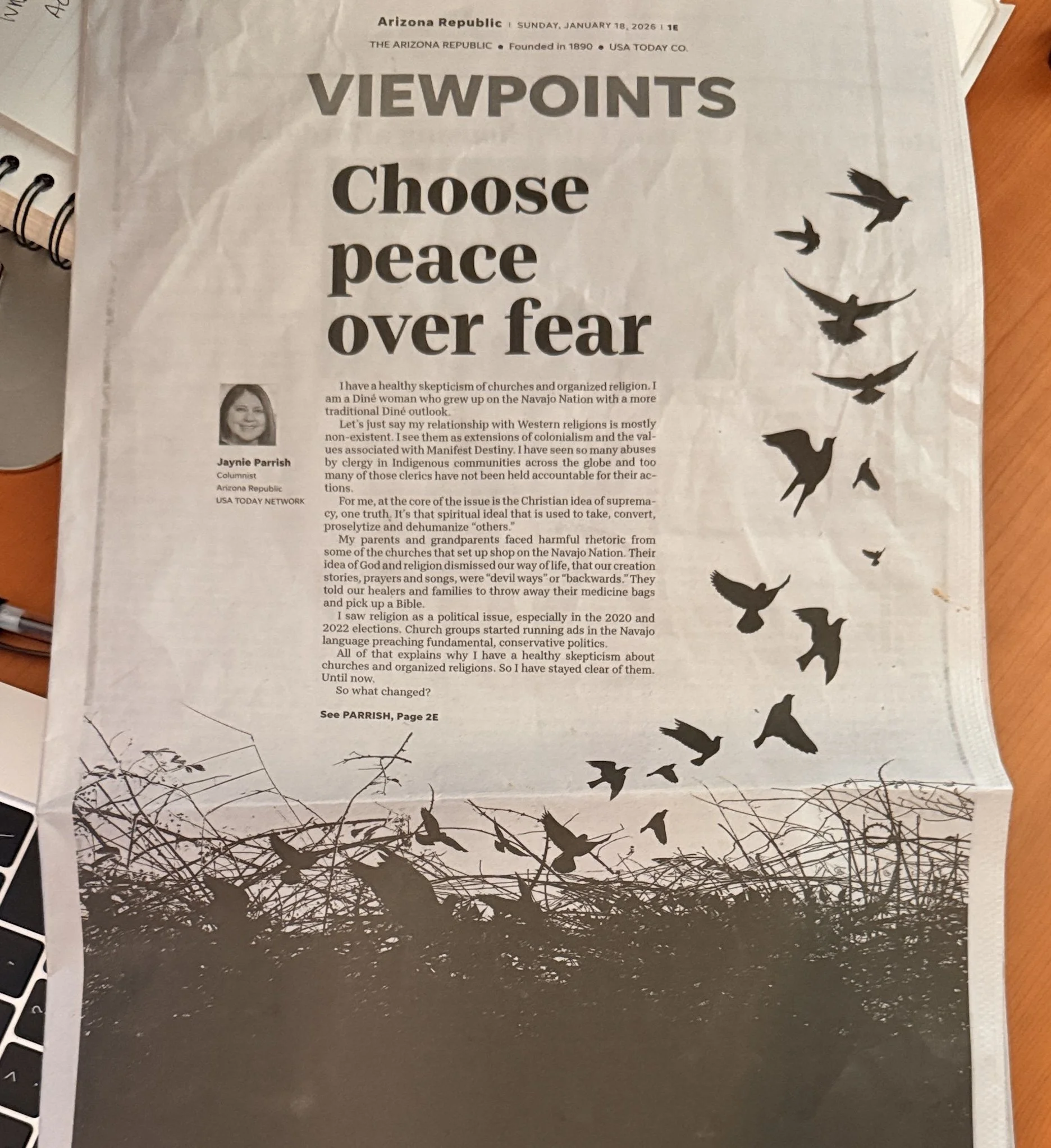
+Sunday Print 1/18/26: Choose peace over fear.
+ Online edition 1/15/26: Standing up to fear, violence is leap of faith | Opinion
Standing up to fear, violence is leap of faith | Opinion
People of all races and religions can work together to end political violence when we choose peace and community over incivility and angry words.
Jaynie Parrish For The Republic
Jan. 15, 2026Updated Jan. 18, 2026, 5:01 a.m. MT
I have a healthy skepticism of churches and organized religion. I am a Diné woman who grew up on the Navajo Nation with a more traditional Diné outlook.
Let’s just say my relationship with Western religions is mostly non-existent. I see them as extensions of colonialism and the values associated with Manifest Destiny. I have seen so many abuses by clergy in Indigenous communities across the globe and too many of those clerics have not been held accountable for their actions.
For me, at the core of the issue is the Christian idea of supremacy, one truth. It’s that spiritual ideal that is used to take, convert, proselytize and dehumanize “others.”
My parents and grandparents faced harmful rhetoric from some of the churches that set up shop on the Navajo Nation. Their idea of God and religion dismissed our way of life, that our creation stories, prayers and songs, were “devil ways” or “backwards.” They told our healers and families to throw away their medicine bags and pick up a Bible.
I saw religion as a political issue, especially in the 2020 and 2022 elections. Church groups started running ads in the Navajo language preaching fundamental, conservative politics.
All of that explains why I have a healthy skepticism about churches and organized religions. So I have stayed clear of them. Until now.
So what changed?
Church leaders seeking the same things
A year ago I was asked to be part of a community-work group to help prevent, resist and rise above identity-based violence. This group focused on bringing diverse people from across Arizona to share space, listen, learn and build an Arizona statewide resiliency network.
At our first meeting I wasn’t sure who I would meet – possibly scary extremists – on both ends of the political spectrum. But I remained open with a healthy dose of caution. It’s human nature.
Instead I met amazing humans who care deeply about their communities. These are people who believe fiercely in our democracy, who fight for human rights and the dignity of others. Church leaders, veterans, journalists, political leaders, superhero moms and dads, proud aunties and uncles, loving grandmas and grandpas of all ethnicities, orientations and religious beliefs.
Our group met in-person several times throughout the year and each time our bonds grew stronger.
We had amazing facilitators who helped set the stage so we could be ourselves while we challenged one another. We were vulnerable and got to know each other. We had fun, hard conversations, and learned so much from each other. I found new friends and colleagues and became part of a new community.
So when the time came to choose what work group I would be a part of I took it as a sign and personal challenge to be in a working group focused on engaging faith leaders. Any good community organizer knows in order to reach more communities, churches and church folks must be a part of our conversations. Instead of ignoring this group, as I had before, I needed to listen and learn. I needed to hear what some of these church folks were doing.
Turns out we shared a lot of goals. We all want to prevent and reduce violence that targets groups of people based on their identity. The “what” identity doesn’t matter – it could be religious, ethnic, racial, national, or even political.
Here in Arizona, we are no strangers to such political violence. We must reject that approach.
One way violence creeps into our politics is by being careless with the words we use. When contempt and cruelty are spoken, it too easily leads us toward actual bloodshed.
My colleague Don Henninger, a volunteer with Arizona Faith for Peace, shared a great lesson and reaffirmed my faith when he said: “The work of peace is not passive. It is not simply the absence of conflict; it is the daily, active practice of building relationships, creating trust, and seeking solutions that honor all involved.”
That’s what it’s going to take, daily practice and relationship building.
Everyone must speak up, choose peace
As Arizonans we are seeing an increase of violence, there will be more unless we speak up and act now.
Turns out that’s what my new friends have been doing. They are standing up to their own congregations, their clergy, and families, calling out hateful rhetoric, behaviors and policies.
This is courageous and I want to help. We need more meaningful engagement and conversations across faith groups, including those in my communities on the Navajo Nation.
This network I am a part of is challenging me and asking me what I could do better to build bridges, share space, and how can I make it actionable and even scale it.
So here’s a few things we’ve done together. We launched the Arizona Faith for Peace, an initiative working with faith leaders from across various denominations throughout Arizona, and the leaders support and promote a statement of solidarity advocating peace and civility in civic life. More than 70 faith leaders have signed on to this petition. We also plan a series of non-violence trainings and community potlucks. The critical point here is to improve communication and build community.
Let us choose peace.
Jaynie Parrish, Navajo Nation, is the founder and director of Arizona Native Vote, a nonprofit helping to boost Native American civic participation.