By Toni Gibbons Staff writer, Aug 20, 2026 Updated Aug 24, 2026 - Originally published in the White Mountain Independent
Navajo, Hopi and White Mountain Apache tribal members came before the Navajo County Board of Supervisors Aug. 11 carrying different experiences but many of the same concerns: ballots that never arrived, unreliable mail, transportation and broadband problems, voter suppression and the long struggle of Native Americans to exercise their right to vote.
But first, supervisors had to decide whether they would be allowed to speak as their Call to the Public requests had been submitted after the meeting began, normally too late under Board procedures.
After hearing from the residents who had submitted their requests on time, Board Chair Daryl Seymore stopped the meeting and asked supervisors how they wanted to handle the additional requests.
“We’re very clear that these need to be turned in prior to the meeting starting,” Seymore said. “Even if we change the time, it’s agendized that we have the right to do that.”
Vice Chair Dawnafe Whitesinger looked through the additional cards, saying, “So there’s native or native vote. These are all from native vote.”
Seymore asked whether supervisors wanted to allow them to speak.
Supervisor Alberto Peshlakai did.
“I am aware of our protocol here and procedure as far as coming before the Board,” he said. “However, some of the individuals, I believe, this is their first time seeking to come before the Navajo County Board of Supervisors.”
Peshlakai also considered the distance traveled by the tribal residents.
“Based on the vicinity of where these individuals may be coming from, I feel that if it would be okay, if my colleagues on the board would also allow for them to speak,” he said.
Supervisor Fern Benally agreed, as she addressed the speakers, “I know it’s your first time. You might still be nervous and not able to read all the wording. So I think that we should give them an opportunity.”
Seymore said, “We’ll make this exception for you, this time,” with the provision that each supervisor agreed to yield three minutes of their speaking time.
‘I’ll be honest, I’m concerned’
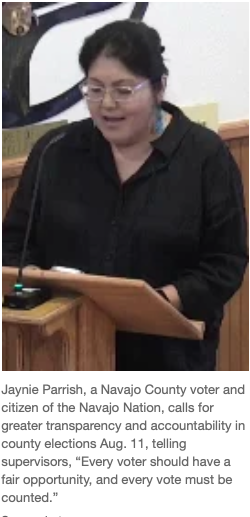
Jaynie Parrish, a Navajo County voter and citizen of the Navajo Nation, calls for greater transparency and accountability in county elections Aug. 11, telling supervisors, “Every voter should have a fair opportunity, and every vote must be counted.”
Jaynie Parrish was first.
“I’m a Navajo County voter. I’m from Arizona and a citizen of the Navajo Nation,” Parrish said. “I’m here to ask the board to commit to the highest level of transparency and accountability in showing how we run elections here in a county with so many Native voters. I’ll be honest, I’m concerned.”
Parrish said she had been following election coverage locally and statewide and believed the issues being raised went beyond speculation.
“The concern is important because issues that have been raised are not just guesses, but documented, thoroughly documented failings,” she said.
Parrish then turned to former Navajo County Recorder Timothy Jordan.
“What started this concern is when the county elected a man in 2024 as our county recorder, who pulled a gun on two young men, Native men, during a road rage incident,” Parrish said. “He was later indicted, appointed and replaced. He then resigned.”
She continued with current Recorder David Marshall, whom the Board of Supervisors appointed to replace Jordan.
“The board then appointed his replacement, a former state legislator who, by his own voting record in the Legislature, supported banning vote centers and restricting mail-in voting,” Parrish said. “He’s the one overseeing our elections now.”
Parrish also raised the more than 1,300 early ballots returned by the U.S. Postal Service as undeliverable before the primary election, an issue county officials had discussed earlier in the meeting.
“Nobody said for sure what’s happening, but I guess we’ll learn more,” she said. “But this is the kind of operational breakdown that can erode trust.”
Parrish contrasted those concerns with what she described as Navajo County’s history of conducting elections fairly and working with tribal communities.
“The process was never perfect, but I think we’ve had decent, transparent folks who were fair and worked with tribal nations and citizens to ensure that every vote was counted,” she said.
She called on supervisors to continue that tradition. “We need this board to uphold the law and demand transparency from our county offices, especially our recorder office, whose critical job is to manage voter registration,” Parrish said.
She also made clear that tribal communities are watching what happens. “I will be watching and continue to pay attention, and so will my family and my community in Kayenta and across the Navajo Nation and in other tribal communities,” Parrish said.
“I want our communities to trust our elected officials in the process. We don’t want election deniers who promote voter suppression to be emboldened or amplified. In fact, we need more of the barriers to make voting easier, not harder for our communities.”
Parrish connected those concerns to a much longer history. “We know the legacy of how hard it’s been for Native people to vote,” she said. “And we’re still fighting for that right today. Every voter should have a fair opportunity, and every vote must be counted.”
She ended by asking Navajo County to be an example.
“We already have too many people elected and not that are working every year to make it harder for our communities like mine to vote. Instead, we need Navajo County to be a bright spot for what election should be.”
‘People are trying to take away our vote’

Theresa Ross, a member of the Hopi Tribe and first-time speaker before the Navajo County Board of Supervisors, asks the county Aug. 11 to protect voting access and “set the standards for smooth and fair elections” in Arizona.
Theresa Ross approached the Board next, and immediately demonstrated what Benally had meant about first-time speakers being nervous.
“I’m a little nervous, but thank you,” Ross said. She identified herself as Hopi and explained why she had come.
“I just wanted to come here to make sure that my vote counts and that everyone is clear about what’s going on with the elections,” she said.
Ross said what she was seeing and hearing about voting worried her.
“We see too many news stories about how people are trying to take away our vote, or they come up with tricks that make voting harder or even impossible,” Ross said.
She told supervisors they had the ability and responsibility to prevent that from happening in Navajo County.
“You, as members of the Board of Supervisors, can stop that by making sure that this county is clear about the election process,” Ross said.
She then spelled out what she expected.
“That means that the county officials should not be able to invent rules that do not exist, and that means that the Post Office should work with the county as well as it has always done, instead of creating new barriers for voting,” Ross said. “And we expect the law to be followed.”
Like Parrish, Ross ended not by writing off Navajo County’s election system, but by challenging the county to lead.
“We hope that Navajo County sets the standards for a smooth and fair elections for state of Arizona,” she said.
‘So we know where our ballot is’

Shara Dosela, a Navajo County voter and citizen of the White Mountain Apache Tribe, tells the Navajo County Board of Supervisors at the Aug. 11 meeting about not receiving her original primary election ballot and asks for greater transparency in how the county handles and tracks returned ballots.
The next speaker, Shara Dosela, identified herself as a Navajo County voter and citizen of the White Mountain Apache Tribe.
She began by thanking supervisors “for graciously allowing me to speak today.”
Then she told them what happened to her ballot. “I myself did not receive my ballot for the primary election,” she said.
Dosda called the Navajo County Elections Office and requested another.
“They did confirm that the initial ballot had been sent, but I never received it,” she said. “Thankfully, I did get my ballot after calling and I got confirmation that my vote was counted.”
But getting her own ballot did not resolve her concerns. She asked the county to explain in detail how an address is determined to be insufficient or vacant and what happens when a ballot is returned because of a change of address.
“How are those dealt with?” she asked. “Are they sent out? Are they sent to the new address after they’ve been returned?” What she wanted, she said, was “transparency on that information, so we know where our ballot is.”
Dosda also questioned how far the county goes to notify voters when a ballot has been returned because of an insufficient address. “How do we know that they’re getting that information?” she asked. “Are they being called? Are they being texted? Are they being emailed?”
Dosda ended by thanking “the team of clerks and other election workers who carry out the mechanics of democracy.”
“These are divided times, which is why it’s essential that the board set high standards of transparency and require that the state law be followed precisely to protect our right to vote,” she said. “Voting should be easy, fair and accountable.”
‘Real barriers to full participation’

Triston Black, who lives on the Navajo Nation, speaks to the Navajo County Board of Supervisors Aug. 11 about barriers facing rural and tribal voters and the importance of teaching young people that their voices matter in county government.
Triston Black brought the final Native voice to the discussion.
Black said he lives on the Navajo Nation and grew up in Black Mesa and Baby Rocks mesas outside of Kayenta.
“Today I’m submitting this comment to urge the board to prioritize election protection, but also access for voters all across the county,” Black said. “Voters in Navajo County continue to face real barriers to full participation.”
Black listed some of those barriers: limited transportation, broadband connectivity needed to check voter status and unreliable mail delivery in rural and reservation communities. He also raised concerns about ensuring ballots are counted and minimizing errors in the signature verification process.
He asked supervisors to support continued investment in sovereign lands and greater coordination when unexpected events interfere with an election.
“On Election Day we saw a lot of flooding, we saw some power outages and a lot of unforeseen issues on Election Day,” Black said. “So what is the coordination plan for that?”
Then Black explained why the discussion mattered to him beyond a single election.
He teaches an Indigenous democracy class to young people in tribal and rural communities across the county.
“In this class, we talk to young people about how county government works, why county-level decisions impact roads, water, health and our elections,” Black said.
“We talk about the importance of staying informed, showing up to board meetings like this one, but also understanding that their voice matters and decisions are made here in Navajo County,” he said.
Black pointed out that those young people are already watching.
“For a lot of young people that I work with, they’re paying attention to what’s happening in our county,” he said. “And they are the next generation of voters, leaders, and they deserve a county that protects their right to vote without any obstacles.”

Photo: Navajo County and Navajo Nation voters attend and submit public comment to Navajo County Board of Supervisors.